
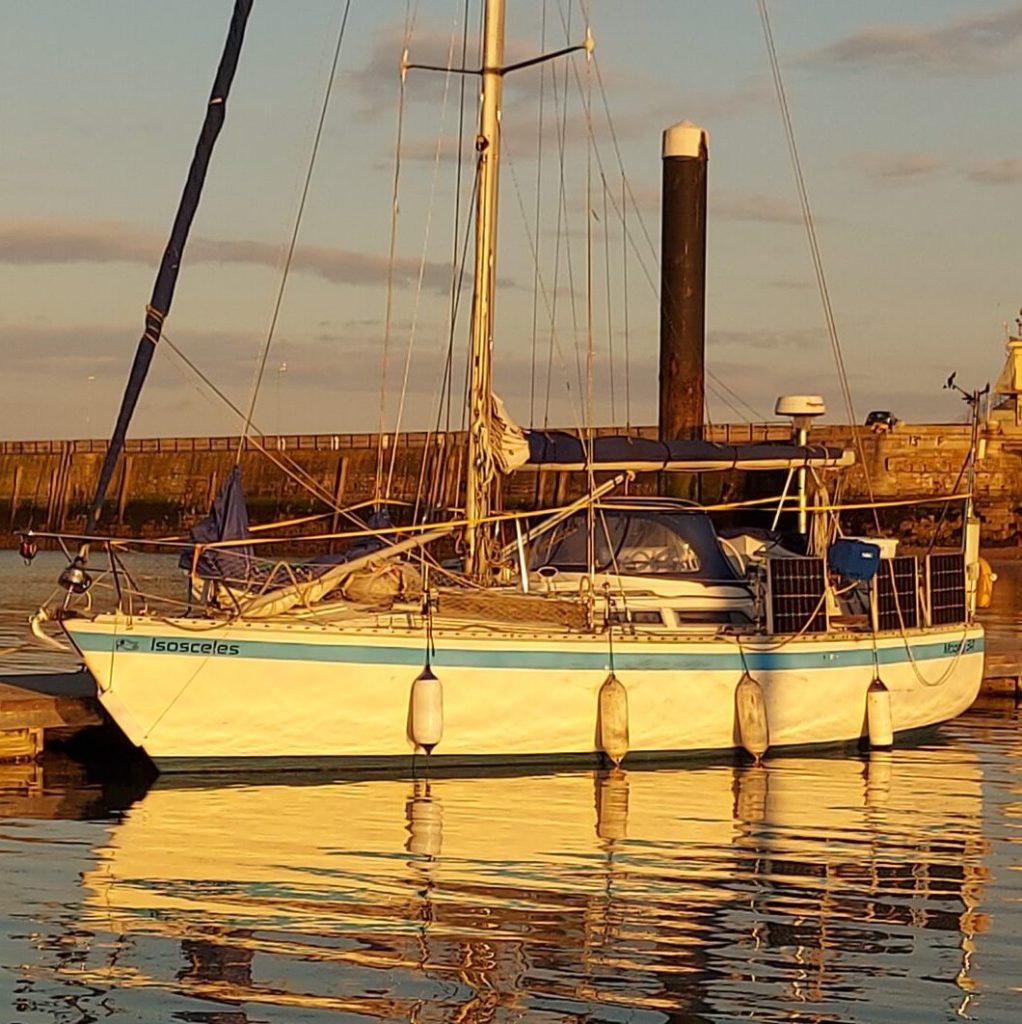

This is an edited and updated version of the original post, which was published on my original blog ‘sailingsouth.org’ in May 2023.
When you are planning a grand adventure, you look at all aspects of what you are doing. Look at the people and places you’re visiting; the sights you want to see. Of course, you should pay attention to the obvious pitfalls and dangers you may face. You want to avoid a bad experience and plan for a great one.

However; sometimes the more you look and plan, the more negatives and dangers begin to creep up on you. Occupying you. If you leave them unchecked, they can eventually overwhelm your thoughts. The trick in life is don’t concentrate on negatives; start doing before you get overwhelmed.
I have been planning a sailing trip around the British Isles for several years. It all started with the dream that one day I would sail my own boat into Lough Swilly in Donegal, in the Republic of Ireland. This was where I learned my passion for sailing. I decided at a young age that one day I’d cast off the lines. The plans only grew and developed over the years. I decided that, once I retired, I’d run away to sea. This developed into a plan to sail all around the coast of Britain. I wanted to re-visit some old haunts and explore a host of new places.
I’ve read the books, articles and blogs written by those who went before. I spent many hours planning a route. I researched some of the harbours and stopovers I would be most likely to use. I’d done the basics of the ground work, the details would come as I went along.
There are always dangers around the coast to catch out the unwary, and sailing a boat at sea has its own dangers. But with a little care and attention, as well as a modicum of common sense, these can be managed. The biggest problem a boat faces is when you bring it close to land. Rocks have a nasty habit of putting holes in boats if they come into contact, but those tend to be well charted around the British Isles. Sandbanks can be remarkably solid objects if you happen to find one. And they can move almost overnight in a big storm. There are river entrances on the East coast that move frequently. Entrances that have to be recharted every year to see where the channels have moved to.
A wise man once taught me rule one: “Don’t hit [insert the name of the nearest piece of land here]”. If you can avoid boat and land coming into contact then you have a good chance of making it to your destination.
There are also some fearsome headlands. Where the land sticks out it interferes with the tidal flow. In some places, tides can collide and create some uncomfortable, even dangerous, conditions. These are usually only dangerous at certain times or under certain weather conditions. But of course, you need to be aware of those situations and conditions to avoid them.
The tides around the British Isles can be a challenge. When you are on a sailing boat the aim is to try and keep them working in your favour. The overly simple guide to tides is they come in for 6 hours, and then they go out for 6 hours. There is roughly a ¾ hour change in tide times each day. This is because the moon doesn’t take exactly 24 hours to go around the earth, and that controls the tides.

There is also a flow of water along the coast. On the whole, this goes in one direction for 6 hours and then turning back in the opposite direction for 6 hours. That is give or take that ¾ of an hour. Sailing against the tide will slow the boat down, sometimes by quite a considerable amount. If you’re only sailing for 6 to 8 hours this can make a big difference. If you’re out sailing for 12 hours or more it may cancel out and make little or no difference.
Sailing with the tide can give the boat quite a speed boost. A medium sized sailing boat like mine will average between 4 and 6 knots (that’s sea miles per hour). Working with tides can be a bit like walking on a conveyor belt. If the tide is going at 2 knots in the opposite direction to you then that can be a third to half of your speed gone. For every 4 to 6 miles you sail, the tide has carried you back 2 miles. Of course, if you are sailing in the same direction as the tide then that is a nice boost as it adds to your speed.
There is also the problem of tidal harbours. You can only get into or out of some harbours when the tide is high enough, so you need to time your arrival for a set time. Fate will usually decide, but if it’s in your favour reaching a particular port, it probably won’t be when you leave. Ports where access is limited to particular tide times can make your life difficult.
Then there is the vagaries of the British weather. The prevailing wind over Britain is blowing from the south west. This is good for me leaving on this Round Britain adventure. It would blow me nicely along the English Channel from the Isle of Wight towards Ramsgate and the east coast. Of course in the run up to me leaving the winds are, quite consistently, blowing from the east. For those who don’t know sailboats, they do not sail straight into the wind, the sailing becomes very tiresome and uncomfortable. I’m doing this trip for pleasure, not because I have to, so uncomfortable sailing is not high on my list.
Sailing is not rocket science, if the wind is coming from behind you it will blow you forwards. If the wind is coming from the side you use the sails to make a curved shape like a wing. This drives the boat forwards (with a bit of sideways movement added in). If the wind is in front of you the sails flap a lot and you go nowhere. I want to sail towards the east, but the wind coming from the east was not what I wanted, so I’ll wait until the wind changes.
So that’s the simple job of planning a sailing trip. Avoiding hitting land, work out when you can leave with enough tide, which way the tide is going to be going, when you will be able to get in to a harbour at the other end, which way the wind is going to be blowing and how strong it’s going to be. Simples. Traditional clocks go out of the window, your time is ruled by the moon and the tides. It’s a good job my life has always involved variable shift working and time requirements.
The boat is all ready to go. The new electronics have been signed off. The fuel tank is full and the sails have been checked over. The general clutter of living on a boat has been stowed away or put in storage.
I’m left checking tides, weather forecasts and pilot books. And there we have it. My brain has finally entered the realms of Procrastination, and a general state of over thinking the whole trip. Unfounded fears need to be recognised for what they are and put to one side. If a situation develops I will deal with it. Weather will be checked daily. If it’s bad I’ll postpone a days sailing until tomorrow. I don’t need to be thinking about what is happening on the east coast, or any where else but where I am right now. Tides will be checked for the following day, if I need to delay they will only change by around ¾ of an hour.




You must be logged in to post a comment.